Who was Frank J. Kolak?
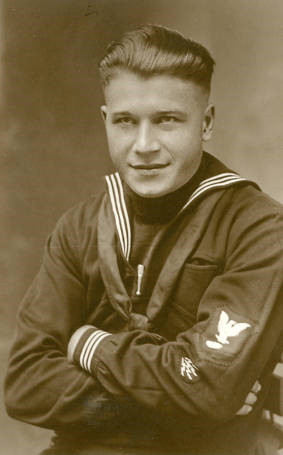
Frank John Kolak was born on the 17th of either August or September in 1893 in Eaton, Wisconsin into a Roman Catholic family. His father, Martin Kolak, was born in Tarnow, Austria, and his mother, Rose Nitka, was born in Archbald, Ohio. The highest level of education Frank Kolak held was the 8th grade, which was the average grade most people stopped attending school. On June 2nd, 1917, Frank Kolak voluntarily enlisted himself into the Navy in Green Bay, Wisconsin for four years. Before enlisting, Kolak was previously a farmer and he worked in an office.
In the Navy, he was first stationed at the Great Lakes Naval Station based in Illinois. After training, he was transferred to Minneapolis, Minnesota, where Frank held the position as a wireless radio operator. He was then later transferred to Harvard University. On February 9th, 1918, Frank was placed on a submarine chaser, U.S. S.C 232, as a radio operator for the Navy. Looking at Kolak’s role as a radio operator, we further explore the experiences of Navy men during the First World War.
What we can learn from Frank Kolak?
The role of the United States Navy in the First World War has been neglected, given that more men served in the Army than in the Navy. With the given information of Frank Kolak, we may learn how life in the Navy was at the time of the Great War and how being stationed as a radio operator on a submarine chaser was in terms of the uniqueness of the occupation.
What we can learn from this Frank’s experience/ occupation in service?
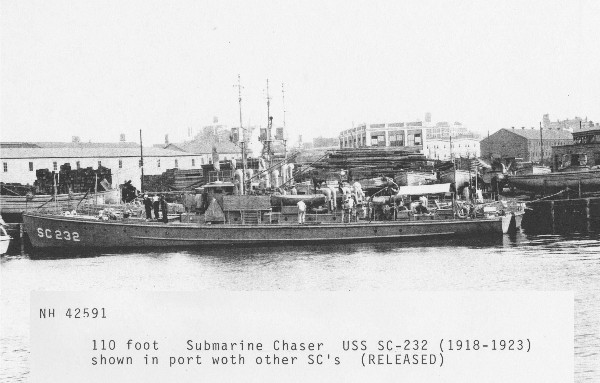
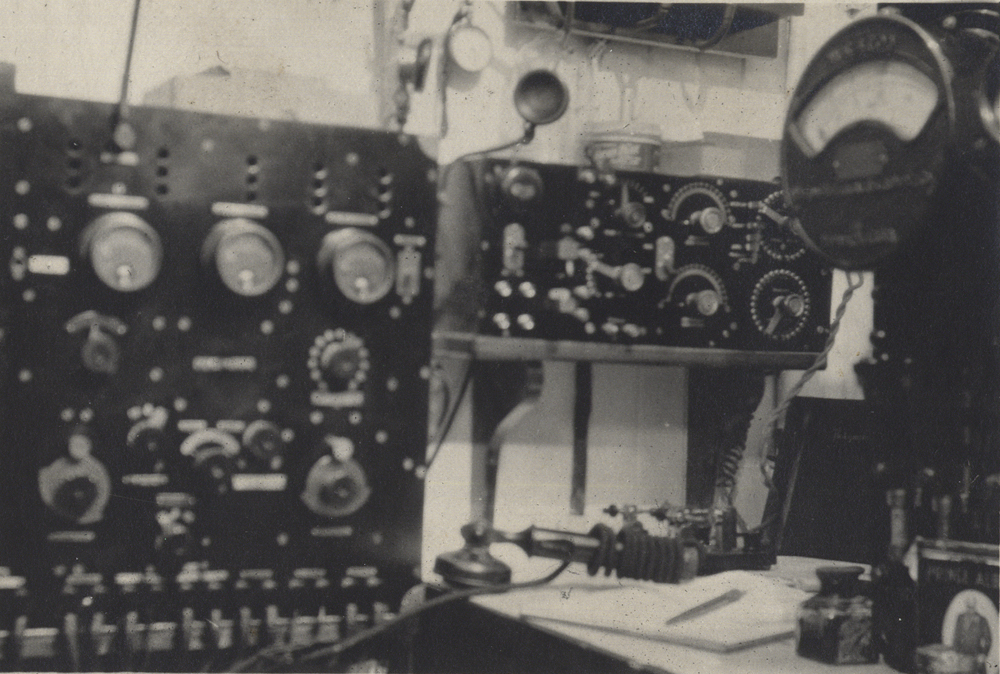
Although Frank Kolak did serve in the Navy, the type of ship that he did end up serving on isn’t the typical warship. World War I Submarine Chasers were made of wood instead of the increasingly common steel or other metals that battleships were being made out of. The interior of the ship consisted of a gallery, a radio room, an engine room, the crew and officers’ quarters, fresh water tanks, and storage rooms.1 Frank’s experience in this ship would have been cramped, as the ships weren’t overly large. Frank may have also experienced cramped conditions while doing his job as operating a radio. With limited space and mobility, small quarters may have very well made it difficult to operate or do any kind of work. The ships being built out of wood was due to there being a shortage in steel. A slight flaw within these plans were that the hulls of the ships often leaked and were in need of constant repairs.2 It can be suggested that although Frank was a radio operator, he may have helped with the repairs if necessary. In order to achieve the specifications for speed, the ship has to be fitted with three humongous engines. Frank, being a radio operator, would also have to have been experienced in Morse code, as radios at the time were used to send messages.3 Radio technology made advancements by being able to operate with voice communication, thus making it easier to communicate.4 Frank would have needed, most likely, to have excellent communication skills and technical skills to operate and communicate with a radio. It can be suggested that radios, being a relatively new invention at the time, could have been very static filled during transmissions from one radio to the next. This may have been one obstacle that Frank had to become accustomed to and learn how to get around.
Since subchasers were relatively smaller than other ships, the conditions on the vessels reeked of gasoline and oil fumes. Gases would escape engine rooms, which housed engines, oil tanks, and air tanks, which would cause surrounding areas of the subchasers to be hot and humid due to inadequate ventilation. As a radio operator on subchasers, Frank Kolak most likely dealt with the bad fumes on board. Not only that, it was said that cockroaches, lice, rodents, and other sources of life were on these ships with the men. Having these infestations within the boats made living conditions very bad for the seamen. 5
How were the Submarine Chasers used, such as the one Frank was Stationed on?
While both finding and then combating Imperial German U-Boats was a difficult process, there were many tactics used to fight against submarines when they entered the coastal waters of the United States. Of course there were two cases in which combat with a submarine could take place, the first being on the surface and the other, of course, taking place once the submarine has once again dived below the surface of the ocean. At a time when German U-Boat was spotted off the coast, a multitude of different resources would be deployed to hunt the sub down, among those of course being the different types of Submarine chasers. It can be suggested that it was common for Submarine Chasers to be sent out in Squadrons of 12 ships and then subdivided into two groups of Six ships.6 While it seems that there are multiple different types of this class of ship, the tactics used to force the submarine into a trap or engagement seems to be the same in most cases. As stated previously a submarine can obviously surface, during this time it was required for submarines to surface both to engage a ship they were hunting if they wished to use the deck gun or to recharge the subs batteries, this fact was reportedly used to the advantage of the Sub Chasers, whose ships were faster than a Surfaced Sub, and as a sub could only stay under the surface for a set period of time, one general strategy seems to be to simply follow the offending sub, harassing it with ship mount depth charges along the way, until its forced to surface once more and then either engaging it with the Squadron or forcing it to engage larger types of ships.7 It can be suggested that Frank played a critical role during these operations, as a radioman on the ship he was not only responsible for the communication of orders between his ship and the others in his squadron, but also likely communicating the positions of U-Boats to the rest of his hunting group and even to other squadrons of ships. 8 However, even though he was trained in the use of the wireless radio, it can be suggested that he would also be proficient in at least two other forms of communication. First of these would would be the telegraph, these would likely have been used by Frank to send coded messages to the other ships. The other method he would have been proficient with would have been hand signals, although it was likely these weren’t commonly used.9
How were the ships employed?
But upon entering the war, the Navy suspended the building program and prioritized the assembly of destroyers to fight against submarines.10 Although the United States entered World War I relatively late, U.S. boatyards were able to manufacture ships that were quickly needed for war and for transportation. The war against submarines required a different type of warship to counter the German. They needed small boats that were suited for escorting and for hunting duties, therefore, the American Navy developed the “subchaser” craft. Because of how much smaller submarine chasers were, the normal capacity was about twenty three enlisted men with two officers. Among the crew, the typical roster had a chief machinist’s mate, quartermaster, five engineers, three sound detectors, a chief boatswain mate, a boatswain, gunner’s mate, a cook, five able-bodied seamen, and three electricians and radio operators, to which Frank Kolak would hold position of.11The majority of men who operated the subchasers during the war were men who enlisted merely for the duration of the war.12 It is suggested that Frank was one of the men that enlisted for remainder of the First World War. Most of these men were younger than 30 years old, to which Frank also enlisted by the age of 23 years.
What happened to the ships after WWI?
Only eleven U.S. navy vessel chasers participated in a surface battle during World War I, where they claimed to have sunk two U-boats. It is suggested that Frank could’ve been on one of the eleven chasers since it stated that Frank was in a number of fights with German submarines. After the end of World War I, no chasers were officially credited with any kills in WWI because they lacked debris to prove they sunk U-boats. It was recorded from eyewitnesses that they did sink some submarines, but they did not provide enough evidence. It was only in the Royal Navy records that there was a “probable” sinking by a U.S. chaser within the British waterfront.13After the war, twenty four U.S. chasers spent months clearing up mines within the North Sea. A large majority of subchasers that were built were sold to the French, and some chasers were transferred to other governments and other foreign military services. The rest of the unwanted subchasers were sold for civilian uses and for scrapping. 14Although convoys had their doubts on the America and their naval commands, the United States was extremely valuable when it came to the source of anti-submarine craft despite the flaws.
What was happening during the time Frank joined the Navy?
Frank found himself enlisted in the United States Navy during a time of flux and transitions for sea warfare between the Western led entente and the allied central powers of Hungary, Germany and the Turks. On January 9th of 1917 Germany declared an official unrestricted policy of submarine warfare opening up any and all ships to potential attacks from the deep sea. Germany had specifically announced to the United States its intention of abandoning all legal restrictions on naval warfare in certain designated sea areas. The announcement stated that “From February 1, 1917, sea traffic will be stopped with every available weapon and without further notice.”15 The battle of Jutland during the mid-months the year prior had seen naval warfare take giant leap forward as a primary tool of use by most countries involved who had the means to do so as opposed to a more logistical, transportation, and defensive focused implementation leading up to that point.
Conclusions
The control of the sea is the most fundamental mission of the Navy. Although the United States was famously late to send troops into battle, through Frank Kolak’s experiences within the First World War, we were able to engage ourselves with the many obstacles that came with being a part of the United States Navy. Many of those who enlisted into the Navy, like Frank, were more than likely enlisting for the remainder of the war. Through Germany’s declaration on unrestricted submarine warfare, submarine chasers were built to combat German U-boats on the coastal waters. With Frank’s experiences, we were able to learn the specs on how submarine chasers located German U-boats through the uses of radio technology. As a U.S. Navy radio operator on a subchaser, Frank, more than likely, took part in harsh, cramped living conditions in the small 110 foot vessel at sea, where they had to constantly search for strong signals of German submarines to alert other allied vessels. The subchaser Frank was on took part in fighting German U-boats, but because of the lack of evidence, besides eyewitnesses, to prove they sunk U-boats, no United States subchasers were credited with any kills in the First World War. After the war, majority of subchasers were sold off and given to foreign governments. Despite the U.S Navy’s contributions being overshadowed in World War I, Frank Kolak’s experiences helped prove that the United States Navy did help at very critical moments in muting German submarines threats in the Great War.
- Todd Woofenden, “ U.S. Submarine Chasers in the Great War,” The United States World War One Cenntenial Commission, Accessed November 21st, 2019.
- Ibid.
- National Museum of the Marine Corps, “War Communication during WWI,” Accessed December 4th, 2019.
- Ibid.
- Edward M. Coffman. The War to End All Wars: The American Military Experience in World War I. University Press of Kentucky, 1986:115. www.jstor.org/stable/j.ctt5vkkbm.
- Marion Eppley, “Anti-Submarine Patrol.” Scientific American 116, no. 9 (1917): 222-23. www.jstor.org/stable/26017648.
- Ibid.
- “Chasing Subs: Instructions and Doctrine.” The Subchaser Archives, 18 Feb. 2009, https://www.subchaser.org/instructions-doctrine.
- Ibid.
- Still, William N.: Crisis at Sea. The United States Navy in European Waters in World War I, Gainesville 2006.
- Franklyn Brown. “SC-1 CLASS 110-FOOT SUBCHASERS (1917-1918): Part Two”. Nautical Research Journal 48, 4 (2003). 194-199.
- Edward M. Coffman. The War to End All Wars: The American Military Experience in World War I. University Press of Kentucky, 1986: 115. www.jstor.org/stable/j.ctt5vkkbm
- Franklyn Brown. “SC-1 CLASS 110-FOOT SUBCHASERS (1917-1918): Part Two”. Nautical Research Journal 48, 4 (2003), 194-199.
- Ibid.
- Frank Jr. Blazich, United States Navy and World War I: 1914–1922, https://www.history.navy.mil/research/library/online-reading-room/title-list-alphabetically/u/us-navy-world-war-i-redirect.html.