Who was Anna Kochanski?
Anna Kochanski was a Polish immigrant who lived in the town of Howard in Brown County, Wisconsin. Evidence suggests she had no children and lived alone with her husband, Adam Kochanski. Anna, at age 48, was charged with murdering her husband. She shot her husband and he later died in the hospital.1 In December of 1934, when her court case was filed, she pled not guilty on the grounds of self-defense. An
Learning from Anna Kochanski
Anna Kochanski is very unique because she was one of the very few women charged with murder. Her case can reveal how some women who committed violent crimes were treated in the justice system in the early 1900s. Crimes, especially violent offenses, were often associated with men, since women were viewed as weak. Deeply ingrained stigmas about women’s abilities have affected the overall narrative because “Historically, commentators have explained women’s lesser in- involvement in crime as an ‘underachievement’ attributable to their biology or sexuality”4 The result has been the existence of minimal research regarding women in connection with violent crime. The belief that a woman could be capable of a violent crime such as murder, was only held due to people’s perception that she was innocent or that there was something terribly wrong with her.5 While there is interest in studying women offenders the majority of criminal offenders are men and, therefore, that is what historians have primarily researched.6
Women who committed crimes went against the normative views that women were delicate and nurturing to others.7 Women have been characterized because of how the past perceives women. They were always seen as the ones taking care of others. In the early 1900s, women were still looked at in a way that they could be little to no harm to society. There is evidence
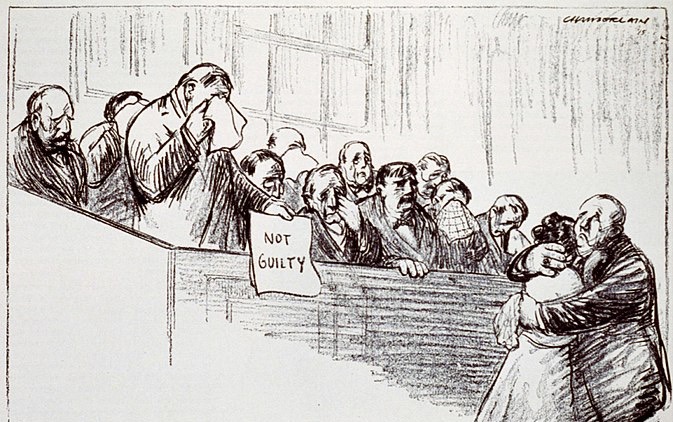
In learning about Anna’s case specifically, the all male jury took pity on her. In the early 1900s, the social norm of being chivalrous and protecting women carried over into the justice system, influencing the outcome of Anna Kochanski’s verdict. A thesis that is widely shared among criminologists is the “chivalrous” treatment of women in the criminal justice system. William Isaac Thomas was the first person to not only acknowledge “chivalrous” treatment by the justice system towards women, but also to write about it in his book, which was published in 1907.11 In addition to the chivalrous treatment protecting women, Pollak also argued that the jury and judge were more lenient on women than men. This is the case for people dictating the law because they relate the female offenders to their own wives, mothers, sisters, and daughters.12 Therefore, this may have played a factor in Kochanski’s trial since the jury was made up of all men.
Conclusion
Women were perceived and treated differently in the court systems during the early 1900s. In the case of Anna Kochanski, she is considered to be a “Lost Life of Wisconsin” because her experience gives insight
- “Mrs. Kochanski Is Acquitted by Green Bay Jury,” Oshkosh Daily Northwestern December 14, 1934.
- State of Wisconsin vs. Kochanski, 1934, Brown Series 65, Box 5999, Folder 16, Brown County Circuit Court 1890-1939, University of Green Bay Archive and Area Research Center.
- Arthur Train, “Courts and Criminals.” New York: McKinlay, Stone & Mackenzie, 1912.
- Deborah W. Denno, “Gender, Crime, and the Criminal Law Defenses,” Journal of Criminal Law and Criminology 85, (1994-1995): 89.
- Deborah W. Denno, “Gender, Crime, and the Criminal Law Defenses,” 87.
- lene H. Nagel and Barry L. Johnson, “The Role of Gender in a Structured Sentencing System: Equal Treatment, Policy Choices, and the Sentencing of Female Offenders under the United States Sentencing Guidelines.” Journal of Criminal Law and Criminology 85, no. 1 (1994): 181.
- Judith Ann Warner, “Women and Crime : a Reference Handbook,” Contemporary World Issues, (ABC-CLIO,LLC,2012) 18-22, 56-57.
- Warner, “Women and Crime : a Reference Handbook,” 18-22.
- Ibid, 18-22
- State of Wisconsin vs. Koehler, 1913, Brown Series 293, Box 428, Folder 4, Brown County Circuit Court 1890-1939, University of Green Bay Archives and Research Center.
- Donna M. Bishop, and Charles E . Frazier, “The Effects of Gender on Charge Reduction.” The Sociological Quarterly. 25, no. 3 (1984): 386.
- Bishop and Frazier,”The Effects of Gender on Charge Reduction,” 386.