What were the legal definitions and processes surrounding the insanity plea in the late 19th and early 20th century?
Who was James L. Hempton?
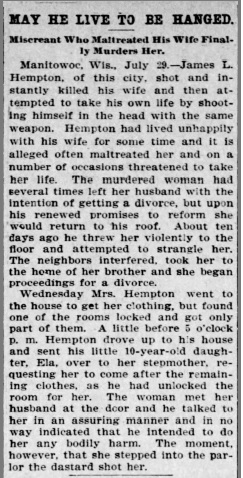
The Dispatch, Moline, Illinois, 29 Jul 1898, Fri • Page 8 Courtesy of Newspapers.com
James L. Hempton was a laborer from Manitowoc, Wisconsin, who was born sometime in the mid 19th century. Before his crime in 1898, Hempton had been in and out of mental health facilities across the state of Wisconsin and suffered from alcoholism. In 1898, struggling with the break-up of his marriage, James Hempton shot and killed his wife Elizabeth, before turning the gun on himself in the parlor of their family home in Manitowoc, WI. His attempted suicide would prove unsuccessful however, and Hempton would be tried in court for murder. Hempton submitted a special plea of insanity but was convicted of murder and sentenced to life in the Wisconsin State Penitentiary located in Waupun. While in prison, Hempton and his legal team would appeal his conviction based on the failure of the court to keep the jury free from tampering. Two years into Hempton’s incarceration, the Wisconsin Supreme Court overturned his conviction and ordered a retrial. This time Hempton would be tried in Brown County due to worries over the ability to conduct a trial free from outside influences in his home county. He once again pleaded insanity, and this time the jury would be convinced, finding him not guilty by reason of insanity. The judge ordered that Hempton be sent to the Northern Hospital for the Insane in Oshkosh, where Hempton would spend nine years before being paroled in 1911. It would not be long, however, before Hempton would make his return to the hospital, after waving a gun around and making threats in Fond Du Lac, Wisconsin. Hempton would spend the rest of his days in the asylum. Research into Hempton’s life provides a unique perspective, and using his story we can walk in his steps to explore the relationship between mental illness and the courts during that time period.
Why is Hempton Important to Our Understanding of the Insanity Plea?
By using James L. Hempton’s life experiences, we can discern a number of observations about the legal processes around insanity pleas in the Wisconsin Criminal Justice system. The first of these observations is the structure in which these cases were deliberated upon. The case files of Hempton’s first murder trial tell us of his two pleas. The first being a “special plea of insanity,” and the second a “plea of not guilty.” The jury must first deliberate and deliver a verdict on the question of the special plea of insanity. In the case of James L. Hempton this happened on two occasions. In both cases, the juries were given explicit instructions to separate the question of sanity and guilt. The instructions to the jury in Hempton’s first murder trial give an impression of a legal system and indeed a society somewhat struggling to grasp the insanity defense. They upheld the right of the jury to take into consideration Hempton’s mental health history, former brain injury, grief over his failed marriage, and alcoholism. But they also provided comments to the jury to counteract the weight of such arguments. They told the jury things like not to “take it for granted,” that Hempton was insane because of his alcoholism and potential brain injury.1 They also explain to them how not being recommitted to the state mental health hospital for a period of two years or over is considered by the law as the individual being sane and having fully recovered.2 They define the insanity defense as a protection for those who committed a crime when they were not of sound mind, however, the definition provided questions the reality of insanity. Starting the definition with, “Insanity, if it exists,” indicates a sense of scepticism on behalf of the court. 3 It was under these circumstances that Hempton was found, in his first trial, to be sane, and later, convicted of murder. Found to be sane, despite two previous stays in an asylum, two brain injuries, a history of alcoholism and a suicide attempt.
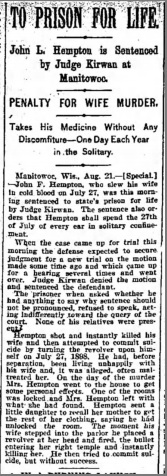
The Weekly Wisconsin
Milwaukee, Wisconsin
26 Aug 1899, Sat • Page 5 (Courtesy of Newspapers.com)
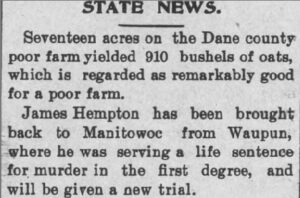
The Post-Crescent (Appleton, Wisconsin) · 3 Aug 1901, Sat · Page 8 (Courtesy of Newspapers.com)
Hempton’s case was indicative of a legal system trying to find its feet on the insanity defense, and a society coming to terms with what exactly qualified as being insane. Just five years prior to Hempton’s trial, in 1884, the Wisconsin Supreme Court had reversed a ruling in the case of Benet v. State of Wisconsin, in which the jury had been given instructions to determine the defendant’s sanity based on the presence of intelligence. The Supreme Court’s basis for the reversal was that sanity at the time of the crime was not dependent on the individual’s intelligence, but instead about whether the offense was committed with the absence of willpower and responsibility.4
As we can see from James L. Hempton’s experiences, the insanity trial defense was one that was still evolving during the late 19th and early 20th centuries, with Wisconsin courts and juries seemingly coming to grips with the definition of insanity. More importantly, the term insanity was and still is a vague legal term that exonerated the defendant of their guilt in an attempt to bring rehabilitation or lock the mentally challenged away forever. Despite developments in psyche analysis, insanity, as seen in the given case, was rooted to problems of physical science. It won’t be until later in the 20th Century when mental health science is interwoven with a psychological treatment and reasserted on a more solid grounds, thus allowing the classifying which symptoms and disorders distinguish the mentally challenged from the less mentally challenged. Until then, the grounds of insanity are still determined heavily based on the English M’naghten rule. In this reasoning, the defendant is assessed with a test of logic.5 With the M’naghten rule, the court questions “the nature and quality of the act” of their crime. In this instance it would ask if Hempton knew that he was hurting his wife or a human being instead of killing something not human. M’naghten rule asks these questions by assessing the defendant’s guilt through their collective knowledge of the act. This is done by raising four questions: what was the defendants understanding of the law, conformity and norms in society, personal harm they caused to themselves by breaking their moral code, and lastly, what was their comprehension and reaction of the harm they caused to an individual. Through assessing these degrees of knowledge of guilt a verdict is often made on the sanity of the individual. This raises further questions. As noted above, it seems that there was not a unison agreement on a legit mental insanity as it was in question. Further records from a past clinics that held Hempton, would most likely be able to specify on his mental despair, by pointing towards more specific traits, such as schizophrenia and paranoia. This then would allow a third party in the present looking at the case to evaluate what legitimacy the insane plea had.
The decision of Hempton’s first murder would go on to be reversed by the Wisconsin Supreme Court, not because of any misunderstanding about how the jury made their decision, but because the jury had been readily exposed to outside influences during the entirety of the trial. By the time Hempton’s retrial comes around to the Brown County Circuit Court in 1902, there seems to be a greater effort on behalf of the judge to clarify in more detail to the new jury on how to comprehend insanity. In the judge’s charge to the jury in this instance, he reiterates, firstly, the determination that sanity and guilt do not go hand in hand, just as insanity and innocence do not.6 Furthermore, the charge details the differences of how insanity is viewed by medical doctors as opposed to how it is viewed by the law, with the legal definition being strictly dependent on its association with an act or offense. 7 One notable difference between this charge to the jury and the one in Hempton’s previous trial is the direction given on the legal determination of the effect of alcohol on the offense. Whilst the court maintains — similar to the previous trial– that the influence of alcohol does not qualify as insanity; it does, however, instruct the jury that if the action was carried out because alcohol use had exacerbated a mental illness, then in that instance it would qualify as insanity by the law. 8 The effect of alcohol on the actions of the accused as determined by the judge in this case differs greatly from that of a similar case of Choice v. State in 1860. The accused in this case had also been subject to a brain injury in their past, and were intoxicated at the time of the accused crime. However, the judge’s instructions to the jury in this case indicated that voluntary intoxication exacerbating a mental illness should be considered as a conscious choice to deprive oneself of reason, and therefore the individual should still be held responsible for any actions committed in that state. 9 The second trial would determine Hempton insane, and not guilty of the murder of his wife, committing him to the Northern State Hospital for the Insane in Oshkosh.
Conclusion
The case of James L. Hempton provides a picture of a court system and society still getting to grips with what insanity was and how to assess it. Hempton’s case allows us to see a period of evolution in terms of how the courts handled the insanity defense, with court records showing slight differences in how the jury were instructed to consider his pleas. The validity of Hempton’s pleas and indeed the jury’s determination of not guilty are also brought into question through the fact that Hempton would go on to re-offend, despite being given his freedom. This leads us to ponder whether the understanding of insanity within the legal system at this time was adequate enough so as to make a determination on who should, or should not be allowed to live freely in public.
- Manitowoc County, Wisconsin, Circuit Court Case Files, Series 50, Box 152, Case No. 310, State of Wisconsin v. James L. Hempton, July 22nd 1899, University of Wisconsin-Green Bay Archives.
- Manitowoc County, Wisconsin, State of Wisconsin v. James L. Hempton.
- Manitowoc County, Wisconsin, State of Wisconsin v. James L. Hempton.
- Gregory Gamling, “Insanity in Criminal Cases in Wisconsin,” Marquette Law Review 17, no. 3 (April 1933): 192-93, https://scholarship.law.marquette.edu/cgi/viewcontent.cgi?article=4003&context=mulr.
- Walter Sinnott-Armstrong, Ken Levy, Ch 12 Insanity Defenses, The Oxford Handbook of Law and Philosophy Criminal Law, (Oxford University Press 2011), 301.
- Brown County, Wisconsin, Circuit Court Case File 229, Series 65, Box 318, folder 14, State of Wisconsin v. James L. Hempton, March 28th 1902, University of Wisconsin-Green Bay Archives.
- Brown County, Wisconsin, State of Wisconsin v. James L. Hempton.
- Brown County, Wisconsin, State of Wisconsin v. James L. Hempton.
- Lawrence P. Tiffany, “The Drunk, the Insane, and the Criminal Courts: Deciding What to Make of Self-Induced Insanity,” Washington University Law Review 69, no. 1 (January 1991): 229, accessed December 5, 2019, https://openscholarship.wustl.edu/cgi/viewcontent.cgi?article=1888&context=law_lawreview.